
How do funded accounts work?
A fee for an account practice test comes first for traders researching how do funded accounts work. If you pass without exceeding the loss limit, your trading profits are divided with the prop firm.
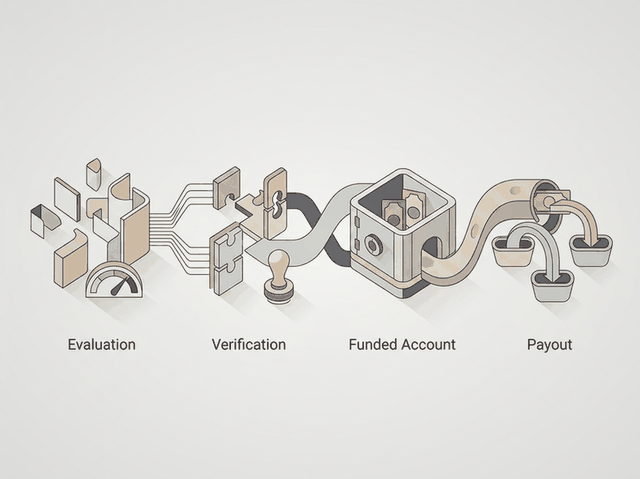
Joining an evaluation by payment and trading the practice round
You can open this kind of account without putting your life savings into a broker account. An evaluation requires an upfront fee payment to a prop firm. You pay to take a trading test in a simulated account that checks your ability to manage risk. The firm keeps a close watch on your risk habits.
During a prop firm challenge, your orders never enter the real market with real cash. This isn't investment advice. Simulated accounts are used for evaluations, and most traders never get to a payout. If you make reckless bets, the firm ends your test and keeps your fee.
How do funded accounts work during the evaluation?
To pass, you must grow your practice balance to the profit goal without touching your drawdown limit. Drawdown is the largest drop in your account balance before the prop firm closes the account. Each balance increase pushes the loss floor up behind your new peak. It never drops again.
The Apex Trader Funding 25K evaluation costs $167 and gives you 30 calendar days to reach the goal. For the LucidPro 50K test, Lucid Trading charges $172 as one payment, with no monthly subscription. After you break a rule, you can start over only by paying Lucid Trading a reset price of $120. MyFundedFutures charges $209 for the Rapid 50K evaluation, and monthly renewals don't apply.
How you activate and move into a funded trading account
Reaching your profit goal ends the test, then the risk desk begins its review. Once the firm has reviewed your trades, you sign the agreement. It then opens your funded account. You might pay an activation fee at this stage, although some firms open your account without any added cost.
Most retail firms keep your orders within a simulated account. You rarely receive direct access to a live brokerage account. Your trades may be copied into live markets by the risk desk, or the company may pay you with its own money.
How profit is split, consistency caps, and payout rules
You can't withdraw cash that same afternoon after profitable trades in a funded account. A cash cushion above your loss limit must be built first, and you must also record enough winning days. The profit split determines your portion of the simulated gains, while the firm receives the rest.
Firms also use a consistency rule to prevent traders from cashing out after a single lucky market swing. Under the consistency rule, trading on one day may account for only a limited share of your total profit. With Lucid Trading, a funded LucidPro payout has a consistency cap of 40% of cycle profit, calculated from your largest single day.
- Apex Trader Funding gives traders a 100% payout split. Your request must be for at least $500, and each Performance Account permits no more than 6 payouts.
- Apex Trader Funding bans automation, and you can hold no more than 20 Performance Accounts at once.
- Lucid Trading gives traders a 90% share. Withdrawals begin at $500, while each household may have no more than 5 funded accounts.
- MyFundedFutures offers the Rapid plan with a $500 minimum payout and no added activation fee.
When do prop firms send your money?
Once your request passes the risk check, payment goes out by bank transfer or through a payment processor. Your chosen prop firm and plan determine how long you wait. Lucid Trading has a payout window of 2 working days. Most Apex Trader Funding payouts take 5 to 11 working days.
Pro accounts at MyFundedFutures pay out every 14 calendar days, and the firm reports paying $300M+ to traders. If you withdraw all your profit, your balance falls to the loss limit. Keeping some cash back gives you breathing room once prop firm payouts arrive.
Rule breaks that lead to funded account closures
Even if you passed the evaluation earlier, breaking a hard risk rule closes a funded account immediately. Your trading screen gets locked by the prop firm, and any gains left unpaid for that cycle are canceled. The most common reason traders lose an account is touching the drawdown floor.
Your account will also close if you keep trades overnight or use automated bots, provided the firm forbids them. Once an account closes, the evaluation and activation fees are not refunded. To start Trading again, you must buy another test and begin from scratch.
Trader questions
Can funded accounts really let you make money?
They can. Traders who follow the risk rules and set aside a cash cushion receive real payouts from established firms. However, most people who purchase a test never finish it or receive a withdrawal. Consider the entry fee money you can afford to lose, rather than a dependable paycheck.
What are the disadvantages of funded accounts?
For a losing streak, tight loss limits leave far less room than a personal brokerage account of equal size would. Strict rules restrict overnight holding and trading around news events, and either can make you leave a good trade early. Since a private company holds your account, it must stay in business for you to receive payouts.
Do you owe the prop firm if one of your funded accounts loses money?
No. Losses from simulated trades never leave you owing money in an evaluation or funded account. Your maximum cash loss is the fee for buying or activating the account. Once your balance goes beyond the loss floor during a fast market move, the firm closes your account.